Singapore Limits Power Banks on Flights: Key Update for Travellers
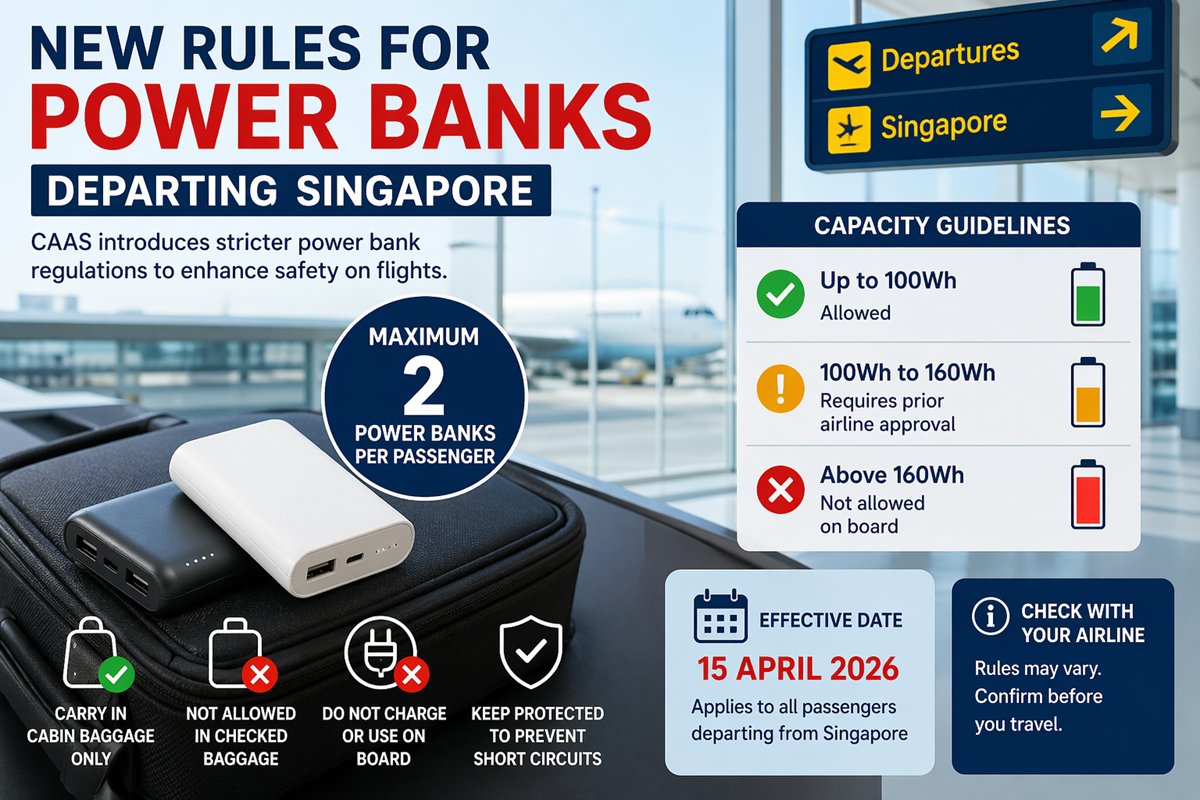
Travellers flying out of Singapore will need to follow new aviation safety rules starting April 15, 2026. The Civil Aviation Authority of Singapore (CAAS) has announced that passengers are now restricted to carrying a maximum of two power banks per person on board flights.
This move aligns with updated global safety standards introduced by the International Civil Aviation Organization (ICAO), aimed at reducing fire risks caused by lithium-ion batteries during flights.
What are the New Power Bank Rules?
Under the latest regulations:
- Passengers can carry only two power banks in cabin baggage
- Extra power banks must be disposed of before boarding
- Power banks are strictly prohibited in checked baggage
- Devices must be properly protected to prevent short circuits
These rules apply to all passengers departing Singapore, regardless of airline.
📅 Effective Date: April 15, 2026
Applies To: All passengers departing from Singapore airports
Travellers are also advised to check with their airlines for any additional restrictions, as some carriers may enforce stricter rules.
Charging & Usage Restrictions Onboard
CAAS has also introduced stricter in-flight safety measures:
- Charging power banks onboard is not allowed
- Passengers are advised not to use power banks to charge devices during flights
Several airlines, including Singapore Airlines and Scoot, had already implemented similar restrictions earlier as part of safety compliance.
Why this rule was introduced?
Lithium batteries inside power banks can overheat or short-circuit, posing a serious fire hazard in aircraft cabins. According to CAAS, these updated restrictions are designed to:
i) Minimise onboard fire risks
ii) Improve passenger safety
iii) Standardise global aviation safety practices.
Where are checks conducted?
Travellers at Changi Airport are checked during the security screening process, which is conducted at entrances to gatehold rooms in Terminals 1, 2 and 3. In Terminal 4, this takes place after departure immigration.
Passengers who do not comply with power bank rules may be committing a criminal offence.
✈️ What Travelers should do before flying?
To avoid last-minute issues at the airport:
- Carry no more than two power banks
- Pack them in hand luggage only
- Avoid using or charging them during the flight
- Double-check airline-specific policies.
Failure to comply may result in confiscation or disposal of extra devices at security checkpoints.
How to calculate a power bank’s Wh rating?
Wh= mAh × V
1000
mAh = milliampere-hour (capacity printed on the power bank)
V = voltage (usually 3.7V for most lithium-ion power banks)
Wh = watt-hour (used for airline safety limits)
How do Lithium-Ion Battery Fires Happen?
Lithium-ion batteries, commonly found in everyday electronic devices, can ignite under specific conditions. Typical causes include excessive heat buildup, short circuits, physical damage, manufacturing flaws, and overcharging, all of which can trigger a dangerous reaction leading to fire.
✈️ Airline-Specific Rules May Vary
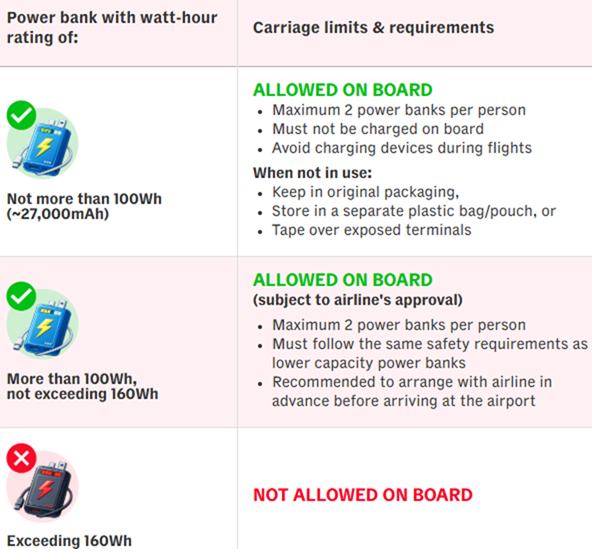
Policies for power banks between 100Wh and 160Wh differ across airlines, so travellers should always verify rules before packing.
- Airlines like AirAsia, EVA Air, and China Airlines require prior approval
- Others such as Japan Airlines and All Nippon Airways may not require it.
Some carriers enforce even stricter limits. For example, Emirates allows only one power bank under 100Wh per passenger, while Southwest Airlines follows a similar restriction.
Final Thoughts
Singapore’s new power bank limit reflects a growing global focus on aviation safety and lithium battery risks. While the rule may seem restrictive, it ensures safer travel for everyone onboard. If you’re planning to fly from Singapore soon, make sure your carry-on complies — or risk losing your extra power banks at the airport.